Table of Contents
Optimizing your page for keywords, metadata, and entity optimization are steps in the right direction. Recently, more focus has been placed on optimizing pages for EEAT (Experience, Expertise, Authoritativeness, and Trustworthiness).
In this article, we are using an app built by Jonathan Boshoff for in-depth EEAT analysis. This app leverages Chat GPT via an API key that scrapes content from pages and analyzes the content against Google’s guidelines regarding EEAT, HCU, and Spam policies. This tool can also help you with core updates as it can highlight areas that need attention.
What is EEAT?
EEAT (Experience, Expertise, Authoritativeness, and Trustworthiness) are key components of Google Search Quality Guidelines that is used by Google Raters to evaluate pages that rank high in SERPS. Based on these evaluations, Google enriches its database and continuously updates the search engines to account for the quality of the web page and provide better results.
In other words, EEAT is not a ranking factor, but an evaluation protocol summed up from millions of rater-generated feedback that provides Google with the necessary ingredients to update ranking factors’ strength and improve the overall search experience.
How to check your Web Page for EEAT score
To check the EEAT Score of your web page you can use the in-depth EEAT Analysis app.
1. Paste Web Page URLs
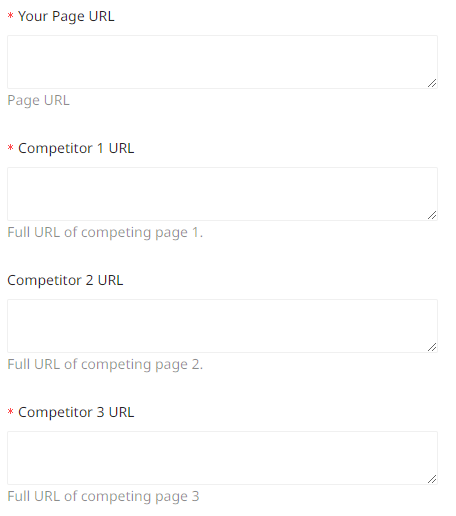
In the following boxes paste your web page’s URL, and 3 competitors URLs to get a good understanding of how your page scores against top competitors:
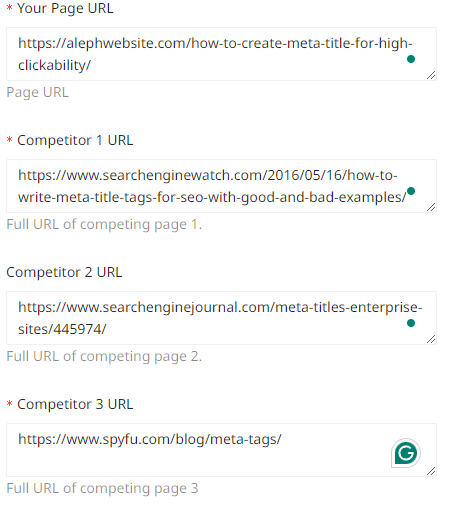
In this example, we’re trying to understand what we can do at Aleph Website to help a web page rank higher for th keyword:
“how to write meta titles”
Adding our web page and 3 competitors that are outranking us:
2. get EEAT Scores
Once the app is done scraping the web pages and running the script for Chat GPT to analyze the content in the background, specifically across 12 metrics:
| EEAT Metric | YP | C1 | C2 | C3 | |
| 1 | Who wrote | 2 | 3 | 4 | 5 |
| 2 | Byline | 1 | 2 | 3 | 4 |
| 3 | First-Hand Experience | 4 | 5 | 6 | 7 |
| 4 | Expertise | 3 | 4 | 5 | 6 |
| 5 | Originality | 5 | 6 | 7 | 8 |
| 6 | Comprehensiveness | 7 | 8 | 9 | 10 |
| 7 | Beyond obvious | 6 | 7 | 8 | 9 |
| 8 | Substantially better | 4 | 5 | 6 | 7 |
| 9 | Additional value from sources | 5 | 6 | 7 | 8 |
| 10 | Descriptive title | 8 | 9 | 10 | 10 |
| 11 | User Satisfaction | 0 | 8 | 9 | 10 |
| 12 | Spelling | 0 | 6 | 7 | 8 |
On the right side, the scores are displayed reflecting the performance of analyzed pages:
- YP – your page
- C1 – 1st competitor
- C2 – 2nd competitor
- C3 – 3rd competitor
How to read the EEAT scores
It is pretty straight-forward as we can see from the table how we compete against top ranking pages in SERPs.
Lower scores indicate worse performance. The lowest being ‘1’ and highest ’10’.
In our case, we’re not using author’s Bio or Author name at the top of the article. This is accounted for in the analysis as authored posts tend to be more trustworthy as we can always relate the content to a human (preferably someone who is an expert in the field).
The app works pretty well in analyzing the content and scoring it realistically, as we’ve seen from the author bio example.
Some of the metrics are vague, like the ‘substantially better’ metric which is not clear at all.
Excluded Factors from the analysis
Here are a few factors completely omitted in this analysis:
| Excluded factors from EEAT analysis | YP | C1 | C2 | C3 |
| Number of backlinks to the web page | 11 | 277 | 6.5K | 206 |
| Number of referring domains to the web page | 4 | 99 | 170 | 106 |
| Domain Authority Score – SEMRush | 12 | 41 | 64 | 41 |
From the table above it can be easily observed that all the pages have at least 20x more referring domains. Backlinks play a major role as they power the PageRank algorithm which is a direct ranking factor used as a core component of Google’s search engine.
Do EEAT Scores reflect real-time rankings?
Let’s take a look at the actual rankings and performance of these pages to be able to determine whether the EEAT scores are reflective of organic traffic shares:
| Ranking Metrics | YP | C1 | C2 | C3 |
| EEAT Average Score – from the App | 4.5 | 5.5 | 6.5 | 7.4 |
| Number of ranking keywords – SEMRush | 0 | 40 | 21 | 590 |
| Organic Traffic (monthly) – SEMRush | 0 | 4 | 21 | 123 |
| Page Postion for ‘how to write meta titles’ | 31 | 7 | 8 | 13 |
C3 has the best EEAT score. It also ranks for more keywords and gets more traffic than the rest of the pages.
In a way, the EEAT score reflects page performance in terms of organic traffic. However, looking into specific keywords, you may want to dig deeper into the semantic networks to understand what other factors may have been updateed in the Google core update.
Recommendations to increase your EEAT score
This app also provides useful recommendations based on the EEAT scores and how our competitors have performed (in areas where they were better than us).
This is the recommendation from this analysis:
To provide a comprehensive EEAT Analysis and improve the YP text based on the provided information and comparison with texts C1, C2, and C3, we will focus on the depth and detail of the content, the demonstration of expertise and credibility, and how well they fulfill the user’s intent. We will then list specific action points for potential improvements based on areas where C1, C2, and C3 outperform YP.
1. Expertise
YP should demonstrate more in-depth knowledge of SEO practices by including case studies or examples of successful contact page optimizations. C2 provides a step-by-step guide on implementing Schema markup, which shows a practical understanding of the topic.
2. Authoritativeness
YP could enhance its authority by including author bios with relevant expertise in SEO and digital marketing, similar to how C3 references Schema.org, a well-known authority in structured data.
3. Trustworthiness
To improve trust, YP should include testimonials or client success stories, as well as clear contact information for the business, which are elements not explicitly mentioned in the provided YP text but are common trust factors.
4. Content Quality
YP can improve content quality by providing more detailed explanations of technical terms and processes. For example, C1 dives deep into the benefits and properties of Schema markup, which adds quality and depth to the content.
5. Fulfilling User Intent
YP should ensure that the content directly addresses the user’s search intent by providing actionable tips and clear, step-by-step instructions on optimizing a contact page for SEO, similar to the detailed guide in C1.
Topic Coverage
A separate report is made for the topicality of the web page. This analysis covers on-page SEO, google business profile share, and schema markup presence:
| Optimization Type | YP | C1 | C2 | C3 |
| On-Page SEO Optimizations | ✓ | X | X | X |
| Google Business Profile Optimizations for Better Search Appearance | ✓ | X | X | X |
| Schema Markup Optimization | ✓ | X | X | X |
From the visible we can tell that topical coverage doesn’t correlate to EEAT scores, nor does it play a role in actual rankings.
Overall Utility of the EEAT Tool
We highly recommend running this application to test some of your pages that took a hit in the last core update. Especially if the drop in traffic was a second in line after the HCU update – meaning that the latest update only worsened the effect. In such case, this tool can quickly highlight areas that need attention.
It’s worth mentioning that the reliability of results generated by Chat GPT (which is leveraged for processing and generating results) is not always trustworthy. Running the test multiple times shows different results.
In other cases we tested the tool, at times, the table came back empty without the data (showing only ‘0’ for all criteria).