Table of Contents
The world of SEO is moving at full speed. The two technologies leading this change in evolution are ChatGPT Search and AI Overviews. An advanced language model, ChatGPT Search changes the whole concept of talking to search engines by offering more relevant, personalized search results. On the other side, AI Overviews make use of AI’s huge capability of processing data to bring a change in the way content is generated and summarized for the users.
Through this article, we will compare these two innovative technologies against each other to understand the changes that could result in SEO strategy and user experience.
1. The difference between ChatGPT Search and AI Overviews
With ChatGPT Search and AI Overviews emerging as transformative forces in SEO, understanding the underlying technologies and core functionalities is much needed. Both technologies leverage AI and NLP to enhance how search engines interpret user queries and deliver the results back. However, while foundational similarities exist between these two technologies, they have different purposes and approaches when it comes to improving the search experience.
Both ChatGPT Search and AI Overviews make it easier for users to find what they need. While large language models power ChatGPT Search to generate long-form conversational responses for any query, AI Overviews summarize large volumes of content and extract big-picture insights or summaries the multiple sources.

Later in this article, we will go deeper into comparing technology and functionalities between Search GPT and AI Overviews.
1.1. The Role in User Experience and Search Results
When it comes to the buyer’s online journey and user experience, ChatGPT Search and AI Overviews play critical roles but in different ways that align with user needs and expectations..
ChatGPT Search is changing how users will interact with search engines to provide intuitive, personalized search results. Instead of just offering results in a simple link format, when users input a query, Search GPT creates a direct response to the query being made. For example, if we were to look for help with our diet we may use ChatGPT Search directly to get a response and other details:

This new evolution improves the user experience by reducing the need for the user to check multiple pages just to get the one with needed information. As it did provide locations in the results so we can purchase the ingredients:

Additionally, we get “Source” list below to verify the information and continue without buyer journey:

This trend toward direct responses suggests a growing trend whereby convenience and time-saving are prioritized over exploration through the search engine itself, which might influence long-term user loyalty and retention.
In contrast, AI Overviews address users who are looking for an overview of a topic more general or a set of content. AI Overviews do not answer explicit questions but rather summarize many sources of information and give the user a small overview of what it is saying.
As such, AI Overviews wouldn’t be activated for the same query: “how can i improve my diet with a nutribullet, give me a simple recipe and stores where i can buy the ingredients”
Instead, we should prompt for a more generic output:

This is helpful for users when they want some basic knowledge about a certain topic without having to read an entire article. But, when it comes to interactions, we may want to switch to Gemini instead. So here’s how the same prompt is answered from Gemini:

Clearly, AI Overviews and Gemini failed at providing geo-location information that would navigate the user ready to complete a purchase.
Aside from that, there are no links in Gemini providing additional info and sites the user can go to:

Instead, you may only double-check the response.
When interacting with AI Overviews, the user will understand in a couple of seconds what the main ideas are, and then proceed further if they wish. It fits the trend of making information overload less complex by offering summaries with simplified content that helps users arrive at a decision faster.
In terms of search results, both Search GPT and AI Overviews can significantly enhance the quality of the information presented to better match the search intent. However, Search GPT tends to drive more dynamic and interactive experiences, while AI Overviews are geared toward delivering bite-sized insights from larger data sets, both improving how users discover and engage with content.
ChatGPT Search and AI Overviews powerfully enhance search outcomes related to the quality of delivered information.
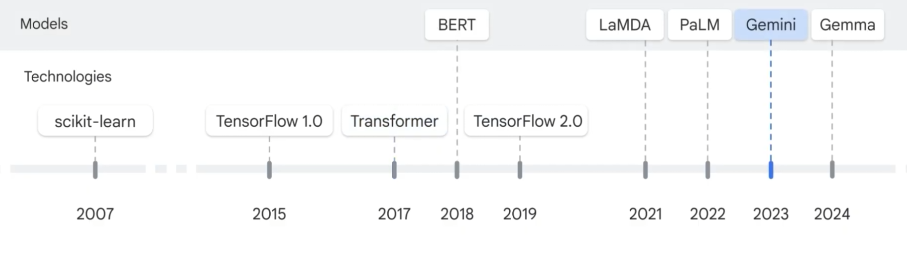
Gemini evolution
After BERT’s release, much has changed for Google and the world. The coming years marked the development of AI tech. Gemini came to life in 2023, and today it uses Grounding with Google Search for its RAG, as well as many other Google features.
2. A Comparison of the Tech Stack
The main difference between ChatGPT Search and AI Overviews not only lies in how they work but also in the very technologies behind them: from language models to perform tasks like OpenAI GPT and Google Gemini, to search engines like Bing and Google. All of them contribute in their way to the unique strengths and capabilities of these systems. Let’s take a look at how the tech stacks of these tools define their outputs and impact on SEO.
2.1. LLMs: OpenAI vs Gemini
The core of ChatGPT Search is an LLM, with OpenAI’s GPT being one of the most prominent examples. GPT is a deep learning model, which is exposed to voluminous amounts of text data so as to return very coherent and contextually appropriate answers to a wide range of questions. The OpenAI GPT architecture is designed to understand the subtlety of human language, process complex prompts, and emit human-like text, making it ideal for answering questions in conversational tone.
By contrast, there is a growing interest in Google’s Gemini. Gemini represents a more sophisticated language model evolving from Bard and PaLM, or Pathways Language Model. Gemini embeds multimodal inputs such as images and videos that will enable the model to deliver even more interactive and cross-format results. It unites the powers of Google’s AI to offer a more holistic search experience.

In conclusion, important divergences in the tech stack for LLMs are the ways in which each model interfaces with different data types and the end user experience. GPT is fundamentally a text-first, expansive interface-that is positioned as optimal for direct answers-while Gemini makes a conscious effort to be more multimodal, tapping into Google’s wider knowledge base along with the array of interactive tools to present search results in a host of media formats.
2.2. Search Engines: Bing vs Google
The role of AI in the future of search will therefore be determined by the underlying search engines that power ChatGPT Search and AI Overviews. Currently, the most relevant is Google, which uses its rich ecosystem to serve up contextually complex answers provided by AI. Google is focused on delivering highly relevant, accurate results by integrating AI into organic search, featured snippets, and knowledge panels.
Meanwhile, Bing has a partnership with OpenAI to integrate GPT models directly into its search. This makes the search experience more interactive and conversational since GPT-powered responses show up right within your search results. While Google may retain its lead in terms of volume and innovation, Bing is making some serious strides in this area, especially when it comes to the feature set using AI.
Ultimately, both are enhancing the user experience with AI, but Google is tuned to accent depth and precision, whereas Bing focuses on making search more conversational and dynamic.
3. Impact on SEO Strategies
As AI continues to reshape the way search engines interpret and deliver content, businesses and creators alike need to rethink their methods to ensure visibility and relevance. Be that as it may, in regard to both ChatGPT Search and AI Overviews, the knowledge of how these technologies will impact SEO would be most valuable to keep one ahead in the competitive digital space.
To align with ChatGPT Search’s capabilities, creating content that answers common queries in a conversational and accessible tone is essential. For instance, a blog post optimized for “how to make healthy smoothies with a Nutribullet” could include FAQs, step-by-step instructions, and a list of local stores to increase its chances of being featured in search results.
Learn what experts say about ChatGPT Search and how it is changing the rules.
On the other hand, AI Overviews require clear and structural content. For instance, an article entitled ‘Top 5 Benefits of Using a Nutribullet for Wellness’ could present concise headings, bullet points, and short summaries to make it scannable for AI systems.
The focus for Gemini should be an optimized page that includes text, interactive visuals such as recipe videos, ingredient lists, and even nutritional analysis in a graphical format. Each of these increases the chances that Gemini will display your content.
In practice, a company selling Nutribullets might combine all three approaches: using ChatGPT Search to provide personalized smoothie recommendations, AI Overviews to highlight the general benefits of their product, and Gemini to showcase engaging video tutorials. This integrated strategy ensures broader reach and a more comprehensive response to diverse user needs.
Now, let’s break down the impact on SEO strategies and the best way to optimize for each:
3.1. Optimizing for ChatGPT Search
ChatGPT Search has started changing the game in SEO, as it now gives direct answers to user queries in conversational tone. It is quite different from classic SEO, where the whole focus was to optimize the content on particular keywords for ranking and drive organic traffic by building links.
Optimizing for Search GPT calls for subtlety. The focus has now been shifted toward developing content that’s understandable and of instant value to users.
- Focus on conversational content and long-tail keywords
As in the example we gave, help with our diet, we can see that ChatGPT Search gives responses like humans, so create content that is conversational with focus on long-tail queries. Content needs to give direct answers to popular questions and break down complex ideas into easy to understand points or short paragraphs. It will increase your chance of being selected as a direct answer.
For example, a query like we did in our example about improving diet with nutribullet might require you to include a step-by-step guide, specific meal ideas, and actionable tips.
- Leverage Schema Markup
Schema markup helps the search engine understand your content better. It will give you more visibility for rich snippets or featured answers brought up through GPT. Structured data about frequently asked questions, products, or reviews serves as a signal for authority and relevance about a particular query.
For instance, if your website provides smoothie recipes, adding structured data with tags for ingredients, preparation time, and health benefits can enhance the chances of your content being pulled into ChatGPT’s answers when a user searches “quick and healthy smoothie recipes for mornings.”
- Optimize for Rich Snippets
ChatGPT Search often pulls from rich snippets and structured data. Clear, high-quality content with listicles, guides, and definitions raises the chances of being featured in quick-answer responses. Include bullet points and direct steps to make it scannable and easy for GPT to extract concise answers.
3.2. Adapting to AI overviews
AI Overviews come with summary boxes and short paragraphs that allow users to see an overview of something straight away without going through the longer text contents. For SEO, this means focusing not only on driving traffic through traditional search results but also on how content is structured and summarized by AI systems.
To adapt your SEO strategy for AI Overviews:
- Prioritize high-level summaries by structuring content with concise, upfront summaries that highlight the key points and give users and AI a quick snapshot of what to expect.
- Organize your content well with clear headings, bullet points, short paragraphs, and H2/H3 tags, making it scannable and easy for AI systems to extract key information.
- Use structured data for entity recognition to help AI systems identify important topics and increase the likelihood of your content being featured as a summarized overview.
- Enhance your content with visuals like infographics, charts, and tables, which help present key points and increase your chances of being included in AI-generated summaries.
- Finally, optimize for featured snippets, as AI Overviews often draw from them, by structuring your content with concise, standalone answers that can easily be extracted for summaries.
4. Conclusion – What’s better?
In all, the rise in ChatGPT Search and AI Overviews has really rewritten the SEO strategy, especially when it comes to creating and optimizing content.
As AI-powered technologies continue to dramatically alter the way in which information is parsed and presented by search engines, businesses will have to shift their strategies toward writing conversational content, leveraging long-tail keywords, and structuring data to optimize for ChatGPT Search and toward well-organized, scannable content for success in AI Overviews.
From the example, we can see that GPT Search has performed better against the given prompt input. However, the overall user experience is very different – Ai Overviews is served along other featured results and links. This makes the two quite different and likely will continue to diverge in separate directions until they find their own respective place in the search markets.
Embracing AI search innovations, marketers can be at the forefront of better visibility, which improves user experiences and expands their competitiveness in an AI-driven search environment.