Table of Contents
When it comes to SEO, understanding the different types of searches is key to developing a successful strategy, they help you align your content with user intent. Search types, such as informational, navigational, and transactional, reflect the varied intent behind a user’s query. Each type requires a unique approach to content creation and optimization. By recognizing these different search behaviors, you can tailor your SEO efforts to better match what users are actually looking for, improving your chances of ranking higher and driving relevant traffic to your site.

1. Keyword-Based Search
Keyword-based search is one of the foundational elements of SEO, where search engines identify specific words or phrases in a query to match with relevant content. Keyword-based search is about aligning your content with terms that users are actually searching for to help search engines deliver the most relevant results. But first, to do keyword-based search optimization, it’s important to understand how one can effectively target keywords within his or her content and how a search engine can rank pages depending on keyword relevancy.

Vector search excels at capturing semantic similarity and handling ambiguous queries, while traditional keyword search is more effective for resolving exact, well-defined queries.
1.1. What is Keyword-Based Search?
Traditional search engines use keyword-based searches to rank the web pages according to the frequency and presence of certain words or phrases, usually called keywords, within a document. Based on this, if a user has entered a query, then the search engine tries to match the keywords of that query to the content on web pages. If these keywords seem more often and in the right context, then the page is bound to show up in the results.
Effective optimization of keywords will enable search engines to identify what your content is all about and, thus, assist it in ranking better for various searches. This is not as easy as keywords in the text; the search engines have grown up, considering intent from search, quality of content, and user experience.
1.3. Yoast and Its Role in Keyword Optimization
Among them, Yoast is the most popular SEO tool, which helps website owners optimize their contents for keyword-based searches. Yoast provides real-time feedback that allows the user to ensure that the content is correctly optimized for keywords. It checks keyword density, title tags, readability of meta description, internal linking, and more, with further suggestions for improvement regarding SEO.
With Yoast, you can set a primary keyword for each page or post. It then analyzes how well that keyword is woven into the content and provides suggestions for further optimization. It also helps with the structure of the content, ensuring it aligns with search engine algorithms.
Yoast offers a very clear checklist to follow when doing the SEO optimizations for a focus keyword in your content. Here is a simplified approach based on those recommendations:
- Place your focus keyword in the title, URL, meta description, first paragraph of your content, and subheadings.
- Maintain a natural flow of keyword inclusion without overstuffing.
- Linking to other relevant pages or posts on your site with anchor text containing your target keyword.
- Use descriptive alt text for images; include relevant keywords where appropriate.
- Try to give readable written content using small paragraphs, bulleted lists, and variations in sentence structure.
Following this checklist means you can have keyword-based searches work for the best in making your content well-matched and follow the current practices of search engine optimization.
2. Vector-Based Search
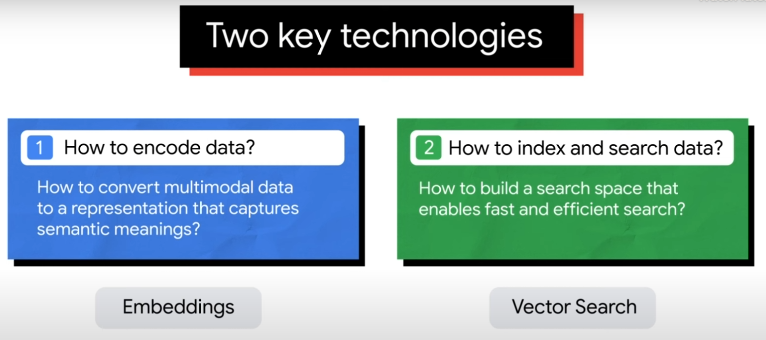
Vector-based search is a method used by search engines to understand and rank content based on its relevance to a user’s query. In this approach, words and phrases are converted into vectors—numerical representations that capture the meaning and context of the text. This helps search engines interpret not only the keywords on a page but also the relationships between words, leading to more accurate search results.

The concept of Word-to-vector embedding really revolutionized search. Thanks to machine learning capabilities developed in the late 20th century, computers where able to analyze text and natural language in ways previously impossible. Natural Language Processing is here introduced to search engines to complete topic modeling which is based on the semantic web (an interconnected corpus of approved and regularly updated documents – mostly wiki pages).
Vector search goes beyond the Google Search software, into AI application functions:
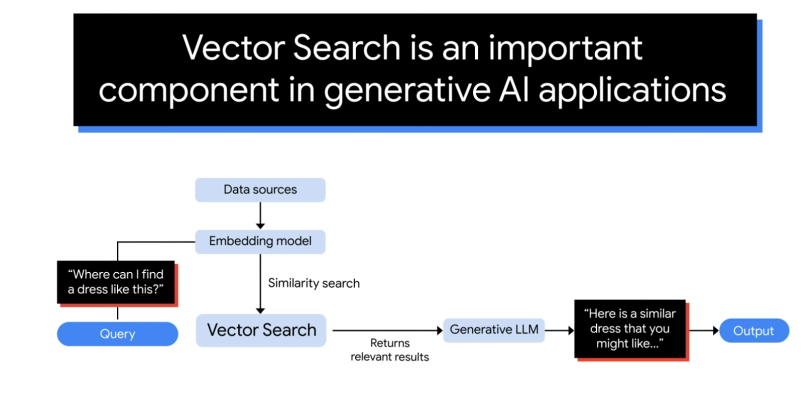
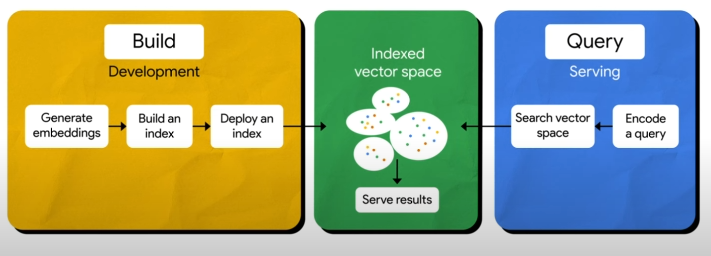
Vector Search works both ways: on the level of content management, but also query optimization.
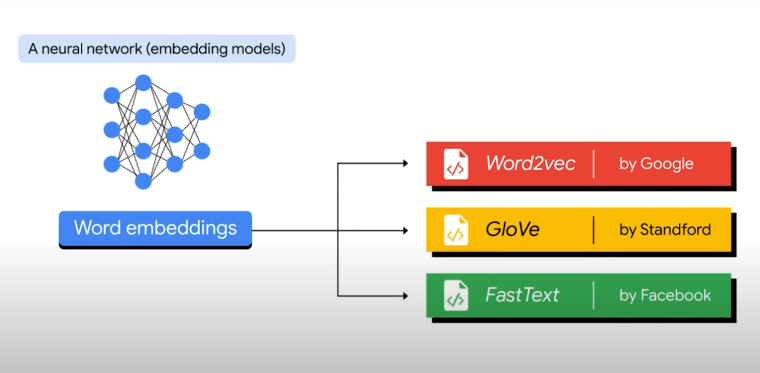
2.1. Word Embeddings
Word-to-vector embeddings have been used in the development of BERT, one of the most important search engine upgrades created by Google.
Using BERT, keywords took the backseat, while semantics and “things” became the use case for search engines. BERT is based on NLP techniques that rely on the semantic web, context analysis, and document linking to become a part of the search engine (directly and indirectly).
2.2. The difference between Word Embedding vs. WDF analysis
Search engines rely on multiple algorithms and search sub-engines to deliver the best user experience. So, the use of Word Document Frequency (WDF analysis) and Word Embeddings (Word2Vec, BERT, etc.) in hybrid engine environments lead to multi-layered processing and delivering of outputs, whether using the classical SERP results, or the sophisticated AI Overviews response.
However, it’s very important to clarify the key differences between these two vector-based search functions:
| Word Document Frequency (WDF analysis) | Word Embeddings (Word2Vec, BERT, etc.) | |
| Vector type | Sparse vector (high-dimensional representation) | Dense vector (low-dimensional representation) |
| Ability | Measures the importance of a word in a document or a corpus of documents | Captures semantic meaning and relationships. |
| Context processing | No context awareness (each word is treated independently) | Yes (words with similar meanings are closer in vector space). |
| Task in practice | Text processing, classification, and keyword analysis | Measures the importance of a word in a document |
2.3. What is TF-IDF and WDF-IDF?
Both WDF-IDF and TF-IDF are the basics of content optimization, allowing search engines to contextualize the word relevance within a document. These methods, in essence, attach a numerical value to the importance of each word in a given text, considering its frequency within the document and across the broader content landscape.
TF-IDF (Term Frequency-Inverse Document Frequency)
TF stands for Term Frequency; that means how frequently the appearance of a word within a document is:

If a word occurs a lot, it might be relevant to the content of the document. However, occurrence frequency doesn’t tell enough to establish its relevance because a word has to be considered against the overall use across a large set of documents.
IDF stands for Inverse Document Frequency: It is the measure of the rarity or uniqueness of a word within the entire corpus of documents.

The rarer a word is the greater its IDF value. A high IDF means the word is probably important to a specific topic or page.
Putting these two elements of TF and IDF together yields a measure that pits the word importance within a particular document against the importance of the word in the whole dataset.

For example, common words like “the” or “and” will have a low IDF value because they are widespread across many documents, while more specific terms like “digital marketing” or “machine learning” will have a higher IDF value if they are less common but more targeted.
From the IDF output, we can easily filter the terms that are considered topical and keyword-based. This is where most vector-based optimization is focused – and what some may term SEO topical authority.
WDF-IDF (Within Document Frequency – Inverse Document Frequency)
Where TF-IDF relies on the word frequencies within singular documents and their rarity within the corpus in question, WDF-IDF, a slight refinement, again assesses the inner structure of the document distribution. WDF-IDF adjusts weights based on the number of occurrences within a document and the regularity of such an occurrence.

Image Source: WDF*IDF in SEO
In an exact sense similar to TF, WDF will measure the occurrence of a certain word in that document. Similarly, it determines how often in the document it finds the recurrence of a specific word.
Note: over-optimization or “keyword stuffing” lowers the quality or readability of that content.
2.4. What is a document corpus?
Google uses the term “document” to refer to a single page, while the “corpus” refers to a selection of web pages that Google search engines have processed.
There are 2 classes of document corpuses:
- Indexed corpus of documents
- Crawled (processed) but not indexed corpus of documents
While the classes carry different weights, both are used to optimize the search engine for better relevancy, wider contextual reference and more precise topicality of user queries.
2.5. How to optimize content using these methods?
For a better understanding of how TF-IDF and WDF-IDF work in real life, different text optimization tools can be used, which visualize both these metrics.
Commonly, the tools highlight the following:
- The word frequency distribution, so you see what terms are used most in your content
- Relevance scores for each term based on TF-IDF or WDF-IDF calculations.
A tool might show you a tag cloud in which the terms important to your document are underlined, enabling you to see in one glance which of your keywords are highly relevant. You might also see charts or graphs of TF-IDF for individual words to identify potential gaps or overused keywords.

By analyzing these visuals, you can fine-tune your content to make sure that important terms are used appropriately and that you avoid keyword stuffing.
For example, if the TF of a keyword is too high and the IDF is low, you might want to change it to more unique and targeted synonyms to help improve ranking potential.
To optimize your content effectively using TF-IDF and WDF-IDF, it’s important to focus on the distribution of word frequencies and relevance scores.
If the analysis of your content reveals that your keyword frequency is too low compared to a baseline or target content, you should aim to incorporate more low-frequency, but relevant keywords. This can help you target long-tail keywords or niche terms, which are often less competitive but can still attract highly targeted traffic.
Similarly, if your content has a high frequency of common keywords that are irrelevant or too general (with a low IDF score), it’s important to either reduce their occurrence or replace them with more specific, high-value keywords. This prevents keyword stuffing and ensures your content remains focused and optimized for search engines.
By visualizing word frequency distributions and relevance scores through text optimization tools, like SEOlyze or Text Optimizer, you can identify keywords that need adjustment. These visual representations help you better understand how well your content aligns with a particular search query or topic.
How does Vector-based search work?

and here the use cases for vector search:

Where is Vector search used in AI?
Vector search is used in AI for solving the hallucination problem.
Made up output is the result of insufficient LLM capability to address a question. In this case, we can use Web Search and “Grounding” to ensure the LLM reverts to searching the net instead of inventing something new and incorrect.
Grounding is done using the method of RAG (retrieval augmented generation) which relies on Vector Search to identify semantic similarity and execute searches in real-time, designed to provide the necessary content for the LLM to answer the question without hallucinating an output.
3. Entity-Based Search
Entity-based search refers to the process of understanding and categorizing specific entities—such as people, places, brands, products, and books—within search queries. Instead of just focusing on keywords, search engines try to discover the hidden sense of a query by identifying such entities and the relationships between them. This is done to aid them in their provision of the most relevant, accurate results related to the intention of the search.
With vector search implemented, we can now use the Vector distance, and other measurements to identify nodes (entities) in the grand semantic web of vectors:

The challenge solved here is determining how close, and far are entities to the query, but also to each other.
There is a tool that does this it represents the knowledge panel in the form of schema markup.

In the given code, among other things, you can find the entity relation score.
“name”: “Brad Pitt”
“resultScore”: 29048.2734375
For entity (nodes) and relationship detection using both keyword and vector search, there are two algorithms responsible:

- Brute-force algorithm
- calculate distance between vector, score the best-related vector (entity)
- capture semantic similarity as a distance function
- TreeAh algorithm
- uses ANN (approx. nearest neighbor)
- calculate all vector distances
- identity semantic similarity (priximity) between all mapped vectors and nodes
- divides vectors in to groups
- creates tree hierarchy of vectors (terms closely related and not very related)
- index SPACES (featured results) using the tree hirarchy of relationships
- ScANN – a newer model faster and better
- uses ANN (approx. nearest neighbor)
Most of the time TreeAh is used, and more specifically, its newer version ScANN, which is now a part of Google AI Vertex.
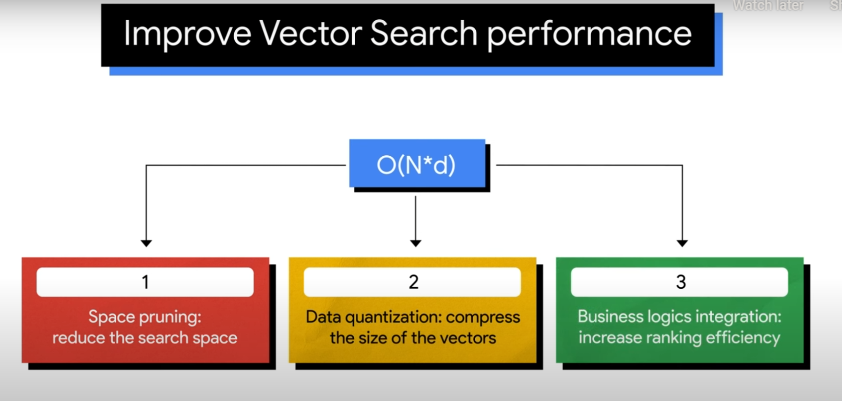
Three important phases for these algorithms to successfully and efficiently deliver entity-related results:
- Space pruning
- Data quantization
- Business logic integration
Space pruning
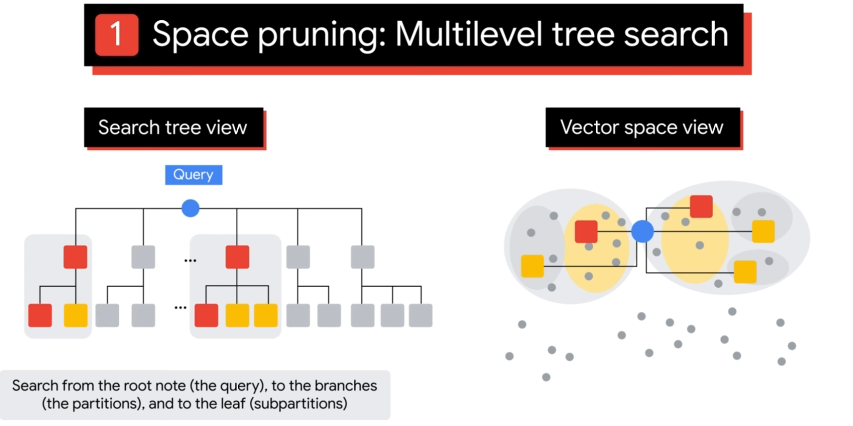
Pruning elimates ‘search space’ which allows for quicker responses (shorter distances between nodes within a predefined view)
As a result, critical vectors are quickly called on to be featured as rich results (knowledge panels, additional helpful features, FAQ, etc.)
Data Quantization
This step is about saving storage space and making Google’s database easier to access:
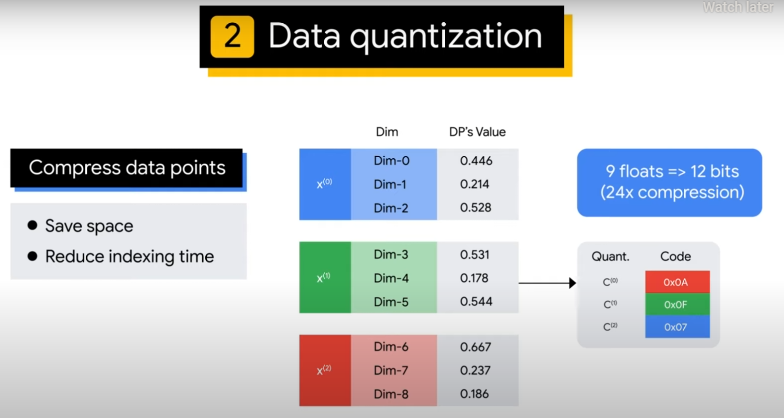
By saving time and compute, Google provides better experience, collects more data and reduces operational costs.
Business Logic integration
This function is used to filter through the final outputs.

One important Google Search Function that relies on this is Google Shopping with its myriad of filters related and connected to entities that will show/not-show specifically filtered products.
This is useful once vectors have been calculated and compressed.
Once all the algorithms are running and the database up to date. Then we can proceed with calls/queries that land us the right entities:
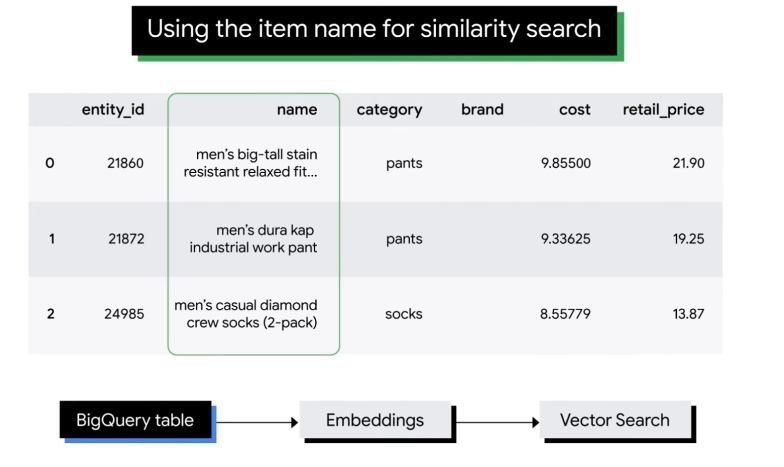
From the image above, we see how Google’s database (BigQuery) is used to store entities and their IDs. Algorithms then use the ID name to match with ID number and execute the rest of entity attributes based on vector proximity and the “k” score for the entity match.

Then Google creates the index based on what the algorithms have completed:

The index contains:
- TreeAH structure of the index (SERP)
- Index design (interface)
- List the number of dimensions captured for the query (entity attributes or properties)
- List number of related neigbors (node neighbors – related entities)
- Respond to query using semantic understanding (ML)

As you can tell, Google has the semantic understanding as part of the vector search experience. This is very helpful as it ties together the query and response (with its dimensions and neighboring nodes).
3.1. Definition and Examples (Brands, People, Books)
One could define entities as unique objects or concepts that really exist in the world and have distinct identities. Entity search is when search engines, using structured data and semantic understanding, identify and categorize these entities to provide more context to search results.
Following are a few examples of entities in various categories:
- Brands: When the user makes a search with the brand name, for example, “Adidas,” the search engines identify it with the entity global sportswear brand. Results would focus on official Adidas websites, reviews, product information, and news.

- People: In this case, when a user types in “Elon Musk,” the search engine knows they want information on the famous entrepreneur. This can give them everything from his biography and news about him to his social media accounts.


- Books: A search like “The Great Gatsby” represents the classic novel written by F. Scott Fitzgerald. Results for such a query are usually pages about a summary of the book, the author himself, reviews, or places to purchase the book.

Such entities are used by search engines like Google to fine-tune their results, so that users get content relevant to those particular objects or concepts. By understanding what entities are, it means that search engines can understand more complex queries and deliver more useful answers.
To learn more about, check out this blog post.
3.2. How to Implement Entity SEO Effectively?
To implement entity SEO effectively, it’s important to focus on creating content that is aligned with the specific entities relevant to your niche. Here are some key strategies to optimize for entity-based search:
- Use Structured Data (Schema Markup):
Schema.org markup provides context to the search engines about the relationships between entities on your pages. Mark up data about books, people, events, organizations, and more, and help search engines provide users with exactly what they’re looking for.
For example, adding Product schema on a product page or Person schema on a biography page provides structured information that search engines can use to better understand and rank your content.
- Optimize for Related Entities:
Understanding how entities relate to each other is critical. For instance, if you are writing about Elon Musk, mention his companies like Tesla, SpaceX, and Neuralink, his role as the CEO, and collaborations or partnerships, such as SpaceX’s work with NASA. Including references to related achievements, like the launch of the Starship or the development of the Tesla Model S, helps search engines establish connections between these entities. This context makes your content more relevant for searches related to Elon Musk.
For discovery of connected entity type, define the main entity first. For example, generate a list of associated terms and phrases using a Text Optimizer. These associated entities should be included in the content without distorting the original meaning. After using Text Optimizer, make sure that all relevant entities in the specified context have been included and that the context has been optimized for SEO. Search engines will grasp the interrelations between these entities, resulting in enhanced relevance and visibility for your content.
An example would be optimizing for the keyword “Great Gatsby” which is the book above.
You use a tool such as Text Optimizer to optimize for related entities:

Here you can see a list of related entities. Ideally, a document (web page) would contain 15 to 25 related entities. That way, search engines are able to capture the exact position of the document in relation to other existing documents discussing related entities.
To further see how the related entity is seen by search engines, click on the related entity:

This prompts a common usage of terms that come before and after the selected related entity.
Within these usage combinations, we often have SEO optimzied semantic triples.
By focusing on entities, you can ensure your content is not only SEO-optimized for keywords but also aligned with how search engines now interpret and display information. This approach leads to more accurate rankings, increased visibility, and improved relevance in search results.
Pay attention to how users are searching for entities. For example, when a searcher queries “The Great Gatsby plot,” Google can tell they want a summary of the book and not some opinion piece on it. Tailor your content to address the different kinds of user intent, whether that is informational, navigational, or transactional in nature.
- Knowledge Graphs
In developing and implementing an SEO for Entities, knowledge graphs should be developed in a manner enabling search engines to contextualize the relationship existing between different entities. The knowledge graph would comprise interconnected pieces of information that the search engines draw on to gain an understanding of how individual entities relate to one another and create a richer context for search results. It helps in building knowledge graph elements for detailed content about entities such that your page is better represented when it comes to particular user queries.
This not only helps in better SEO but also provides the user with accurate and relevant information on his queries, thereby giving them a better experience. With some carefully done knowledge graph, you can establish better understanding about your content at search engines to see better visibility and ranking.
4. Reputation-Based Search
Reputation is a key component in today’s SEO because search engines increasingly prioritize the authority and trustworthiness of content and websites. Reputation-based search involves not strictly keyword-based ranking but uses reputation signals to identify which content should rank better. The factors that contribute to its determination are PageRank and backlinks, as search engines rely on these signals to assess a site’s authority.
4.1. The Impact of PageRank and Backlinks on SEO
PageRank is developed by Google’s algorithm, in which the importance or quality of a page is usually judged by various links pointing back to it, including their number and quality. The basic ideas of PageRank are that one page is generally considered more authoritative if it links to many different high-quality sites. While modern algorithms have gradually evolved from simply relying on it, PageRank still plays a very significant part in the establishment of a certain page’s credibility. The pages with higher PageRank are most likely to rank better because, in the search engine’s eye, they have more relevance and trust.
Backlinks are also important in SEO and the reputation of a page, being the incoming links from other websites. To the search engines, backlinks are treated as “votes of confidence” from other sites that the content is of value and authoritative. Not all backlinks are created equal, though-high-quality backlinks from reputable sources-such as well-known publications or industry leaders-will have a much greater effect on SEO than links from low-quality websites. Furthermore, do-follow backlinks pass link equity, but no-follow ones don’t, although they can help through brand visibility and reputation.

4.2. Best Practices for Building Online Reputation
In building an online reputation, duality of attention has to be given to both optimization for PageRank and quality backlinks.A crucial part of this process is learning how to write SEO-friendly blog posts. Comprehensive, well-researched, and useful content tends to attract natural links. Long-form articles, comprehensive guides, and case studies are examples of the kind of content that enhances your authority and improves the chances of earning links from reputable sources.
Importance of Backlinks for Reputation:
- Guest Blogging: Posting on authoritative, relevant sites for increased exposure and credibility.
- Networking & Collaboration: Collaborate with influencers and bloggers to get quality backlinks and enhance your authority in the industry.
- Backlink Audits: Discard bad links by constantly screening your backlink profile to ensure a good reputation.
- Constant Efforts: Build credibility by consistent content development, building relationships, and attaining quality backlinks to higher rank and better trust.
Brand reputation plays an important role in your online presence. Set up Google Alerts for your brand name to keep an active eye on your brand’s reputation. It will notify you every time your brand or keywords related to it appear online helping you monitor your presence.

Make sure that authoritative websites link back to your site when mentioning your brand name or branded keywords. Having these kinds of links not only strengthens your SEO efforts but also signals to search engines that your site is credible and trusted. Link-less brand mentions still matter for ranking, but use the opportunity whenever possible to build links as that would have a very positive impact on your website rankings!
5. Conclusion
In conclusion, any SEO strategy will be deeply driven by the kind of search: keyword-based, vector-based, entity-based, or reputation-based; whatever the type may be, each would require a different approach. Thorough optimization of content by combining targeted keywords, structured data, and building a reputable online presence, you can significantly improve your website’s visibility and search engine ranking. With search continuing to change, mastering those changes and leveraging the right tools, such as Yoast for keyword optimization or structured data for entity-based search, will keep you ahead of the competition. A well-rounded SEO strategy considering all these types of search will help you reach your audience better, drive relevant traffic, and build long-term authority in your niche.